Pay in installments of $6.43 with
 ,
,
 and
and

Shipping Estimate
USA
- USA
- CAN
- USA
- CAN
Ships within 48 hours · Estimated delivery Jul 15 - Jul 20
 Promo Codes Available:
For Your Every Summer RSVP, with Code: SUMMER15
Description
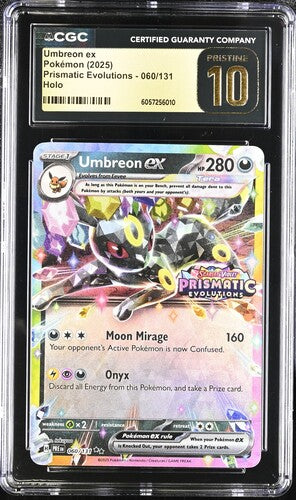
what is a stamped pokemon card Umbreon EX 2025 Pokemon Prismatic Evolutions Stamp Promo Surprise Box Exclusive #060 PSA Authenticated 10 CardUmbreon ex 060 131 Prismatic Evolutions Stamped Promo CGC Pristine 10 CGC Standard Card Grading Scale: Pristine 10 A Pristine 10 is a virtually flawless card to the naked eye. The centering is 50 50, and the card has flawless color and registration. All cards that merit a CGC Pristine 10 grade will receive a special CGC Cards Pristine 10 label. Gem Mint 10 A Gem Mint 10 is a card that has received a 10 grade overall; however, one of the grading
Umbreon ex 060/131 - Prismatic Evolutions Stamped Promo - CGC Pristine 10
CGC Standard Card Grading Scale:
Pristine
10 A Pristine 10 is a virtually flawless card to the naked eye. The centering is 50/50, and the card has flawless color and registration. All cards that merit a CGC Pristine 10 grade will receive a special CGC Cards Pristine 10 label.
Gem Mint
10 A Gem Mint 10 is a card that has received a 10 grade overall; however, one of the grading criteria does not meet the requirements of a Pristine 10. Corners will appear perfect to the naked eye and Mint+ under 10x magnification. The surface is free of print spots and should also display perfect gloss, devoid of any surface flaws. Centering is not to exceed approximately 55/45, and reverse centering is not to exceed 75/25.
Mint+
9.5 A Mint+ 9.5 is a card that displays premium eye appeal for a Mint card. Qualities such as exceptional centering, surface qualities/color or other key elements can elevate a card to a Mint+ grade.
Mint
9 A Mint card has four sharp corners with only minor wear visible. Slight minor flaws on the edges may be visible. The surface must have all original gloss; however, a small number of specks or one minor spot or surface defect is allowed. For TCG cards, cards will have only a few minor manufacturing or handling defects. For sports and non-sports cards, centering must be 60/40 or better for the front of the card, and 90/10 for the back.
NM/Mint+
8.5 A card graded 8.5 has relatively smooth edges with only minor touches of wear. It must have original color borders and gloss. One of the following very minor flaws is allowed: corners are sharp to the naked eye but reveal slight imperfections under magnification; a small amount of minor print spots; subtle focus imperfections of the image. A very slight diamond cut is allowed. TCG cards could show small handing defects.
NM/Mint
8 A card graded 8 must have relatively smooth edges with only minor touches of wear. It must have original color borders and gloss. One of the following very minor flaws is allowed: corners are sharp to the naked eye but reveal slight imperfections under magnification; a small amount of minor print spots; subtle focus imperfections of the image. A very slight diamond cut is allowed. TCG cards could have small-to-moderate handling defects. For sports and non-sports cards, centering must be 65/35 or better.
Near Mint+
7.5 A card graded 7.5 may also have a touch of wear on two or three corners or slightly rough edges. The image may be slightly out of register. A slight diamond cut is allowed, and very slight wax staining is allowed on the reverse. TCG cards could have a moderate defect or a number of small handling defects. For sports and non-sports cards, 65/35 centering is allowed.
Near Mint
7 A card graded 7 may also have a touch of wear on three or more corners and/or slightly rough edges. The image may be slightly out of register. A slight diamond cut is allowed, and very slight wax staining is allowed on the reverse. For sports and non-sports cards, centering should be 70/30 or better.
Ex/NM+
6.5 For a grade of 6.5, no more than one slightly “dinged” corner is allowed, or no more than two of the following flaws: two or three fuzzy corners; slightly rough edges; noticeable print spots. A moderate diamond cut is allowed, and light wax staining on the front is acceptable.
Ex/NM
6 For a grade of 6, no more than one “dinged” corner is allowed or no more than two of the following flaws: two or three fuzzy corners; slightly rough edges; noticeable print spots. A moderate diamond cut is allowed, and wax staining on the front is acceptable. For sports and non-sports cards, centering may be no worse than 75/25.
Excellent+
5.5 At 5.5, the corners may exhibit light “fuzzyness” and very minor rounding. The corners may come to a point but may have one or two “dinged” corners. There may also be chipping on the edges, minor border discoloration, noticeable print spots and/or color or focus imperfections on the surface.
Excellent
5 At 5, the corners may exhibit “fuzzyness” and very minor rounding. The corners may come to a point but may have two to three “dinged” corners. There may also be chipping on the edges, minor border discoloration, noticeable print spots and/or color or focus imperfections on the surface. On cards with scratch-off surfaces, the coating may be removed, but the surface is not damaged.
VG/Ex+
4.5 At 4.5, the corners may display slight rounding. Noticeable surface flaws may include scuffing, scratches or one light crease. While some original surface gloss may be visible, the borders may be off-white, and a small amount of minor staining is allowed. For sports and non-sports cards, the centering is 85/15, and an extremely noticeable diamond cut is allowed.
VG/Ex
4 At 4, corners may display slight rounding. Noticeable surface flaws may include scuffing, scratches and one or more light creases. While some original surface gloss may be visible, borders may be off-white, and some minor staining is allowed. An extremely noticeable diamond cut is allowed.
Very Good+
3.5 A Very Good+ card may have 90/10 centering and four rounded corners, but not extreme rounding. The surface may exhibit one moderate crease or more than one light crease, and may also display scuffing or scratches and loss of original gloss. The edges may have moderate wear, and moderate staining of the stock can be visible.
Very Good
3 A Very Good card can have four rounded corners, but not extreme rounding. The surface may exhibit one moderate crease or more than one light crease, and may also display scuffing or scratches and loss of original gloss. The edges may have moderate wear, and heavier staining of the stock can be visible on both the front and back of the card.
Good+
2.5 A card graded Good+ may have heavier creasing, but the creasing does not travel across the surface from edge to edge. The card may also have some surface damage such as one small writing mark on the back. An extremely heavy diamond cut resulting in a near miscut is allowed.
Good
2 A card graded Good can have heavier creasing that may travel across the surface of the card from edge to edge. The card may also have some surface damage such as a small amount of writing on the front or back. An extremely heavy diamond cut resulting in a near miscut is allowed.
Fair
1.5 A Fair card can have one catastrophic flaw such as a staple hole, small area of missing surface, severe creasing and/or writing on the surface. The card may be miscut.
Poor
1 A Poor card may suffer from major surface damage such as severe creasing that breaks the surface, and/or it may be missing a small portion of the cardstock itself such as a portion of the corner that has been torn away from the card. The card will have multiple catastrophic flaws.
Shipping Notes
- Free Standard Shipping on $100+ Orders to the USA.
- Except Preorder products are shipped in 48 hours.
- Delivery to the USA:
- Standard Shipping : 3-10 business days
- If time is of the essence, please consider selecting expedited delivery for faster service.
Exchange/Return Notes
- We offer a 30-day return/exchange service after receiving.
- Final sale items are not eligible for returns or exchanges.
- To process your return/exchange, please contact us at [email protected]
- Please click here for more details>>> Return & Exchange Policy